
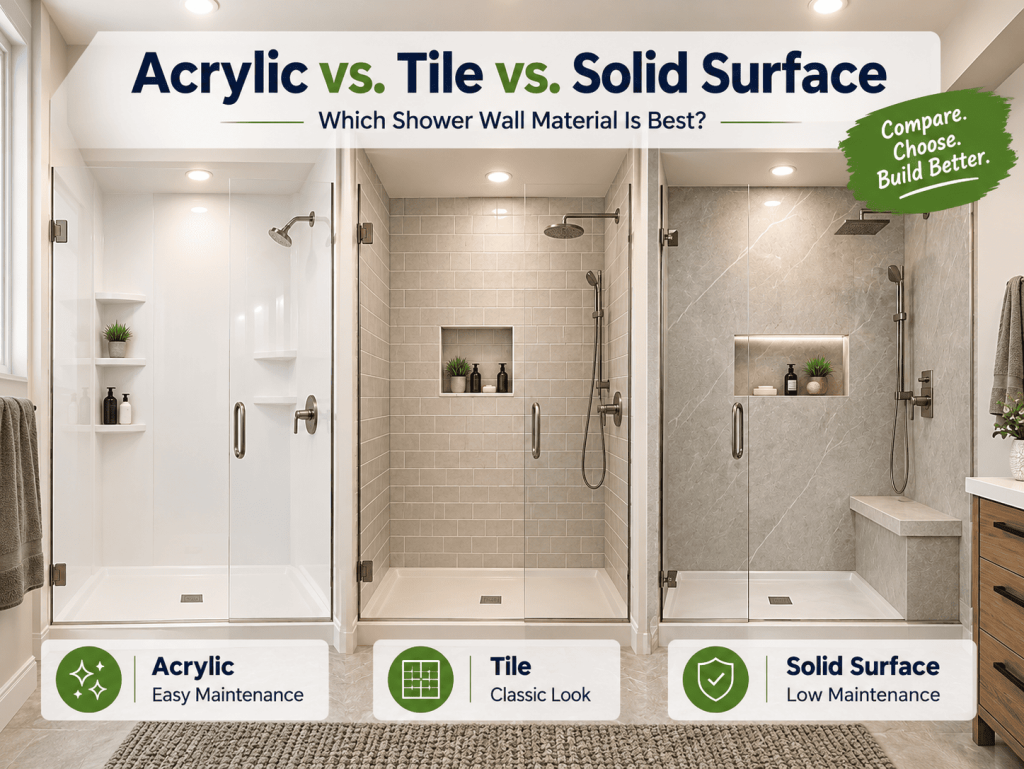
Which shower wall material should you choose?
The key decision factors are:
1. How “cheap” does it look versus how awesome does it look and do I care?
2. How durable is it / how long will it last?
3. How easy is it to clean and keep clean?
4. Is the material something that will keep you having to deal with mold and mildew? (Grout free or not)?
If you prioritize lower upkeep, a grout-free panel wall is usually the practical choice for a tub to shower conversion, and tile is worth its extra upkeep only when a custom look matters most to you. Choose a factory-made, grout-free panel wall, either acrylic or a solid surface or stone-composite panel, if you want a surface you can wipe down. Choose tile if a custom pattern or a particular porcelain or stone look matters more than cleaning time, and be ready to keep up the grout and to confirm what sits behind it. Among panels, a true solid surface or crushed-stone composite is the step up for homeowners who want mineral or stone content in the wall, which the next section explains.
Four things should drive the decision: the maintenance you’ll tolerate, the look you want, how long you can go without a working shower, and whether you want grab bars now or later. Price matters too, but no verified installed prices for this area were available, so the cost section below explains what drives the number instead of guessing at one.
Treat the walls and the shower base as two separate decisions, even though some products bundle them. For example, Sterling’s STORE+ 60″ x 30″ Vikrell shower includes a shower base plus walls, while other quotes may pair one company’s walls with another company’s base. Comparing the two parts separately on each quote makes the bids easier to line up.
What each material actually is
“Grout-free” is a broad sales term, and manufacturers use “solid surface” for materials that aren’t the same. DuPont describes Corian, a true solid surface, as about one-third acrylic resin (PMMA) and two-thirds natural minerals, with aluminum trihydroxide listed at 55–66% in the ingredient table. Kohler takes a different approach and describes its LuxStone shower walls as made of nonporous, stain-resistant crushed stone, although that page doesn’t publish a resin or filler breakdown.
Sterling’s Vikrell is a third kind of product. According to the spec sheet, the STORE+ Vikrell shower is “compression-molded from our exclusive solid Vikrell® material”, and the sheet gives no detailed composition, so it shouldn’t be lumped in with acrylic or with Corian. Swanstone, made by the Swan Corporation, is another panel line with its own care rules, which a later section covers.
Homeowners also mix up acrylic and fiberglass panels, and the research behind this article didn’t include a source that settles how the two compare. The practical answer is the same for every option. Ask each contractor for the brand, the product line and the spec sheet, and if the sheet doesn’t say what the panel is made of, ask the manufacturer directly. Don’t accept a generic “acrylic” label unless the quote names the product line. Two quotes that both say “acrylic” or “solid surface” may be for very different products.
Are panel walls tested for shower use?
The most useful item to look for on a panel spec sheet is whether it lists CSA B45.5/IAPMO Z124 under Codes/Standards. Sterling lists CSA B45.5/IAPMO Z124 under Codes/Standards for its STORE+ 60″ x 30″ Vikrell shower, and it lists CSA B45.5/IAPMO Z124 and IAPMO Certification for its Medley 60″ x 30″ Vikrell bath/shower wall set. If a panel on your quote doesn’t list a standard, ask the manufacturer what the product has been tested to.
DuPont publishes test data for Corian as well. Its technical bulletin reports that Corian passes the CSA B45.5-11/IAPMO Z124-2011 wear and cleanability test, although that result covers the solid surface sheet material rather than a specific shower wall product. The same bulletin reports results for light resistance and weathering, plus ball-impact tests in which the sheet didn’t fracture. These numbers describe Corian only, so you shouldn’t assume another “solid surface” panel matches them.
The research didn’t settle how acrylic, composite panels and tile hold up to year-round Gulf Coast humidity. It also didn’t answer how much expansion gap panels need or what temperature and humidity limits apply to panel adhesives. The manufacturer’s installation instructions are the place to find those limits, so ask your installer to show you the instructions for the exact product on your quote, and ask which caulk the manufacturer specifies and whether the warranty excludes high-humidity or coastal installations.
What keeps a tile shower wall watertight?
A tile wall is a layered assembly, and the tile and grout you see are only the top layer. Whether the framing behind it stays dry depends on the backer board and the waterproofing under the tile, and you can’t inspect either one once the job is finished. For that reason, ask any tile contractor to write down which backer board and which waterproofing method they plan to use before you sign.
Don’t take a contractor’s word that any backer board is fine; ask which current code provision and manufacturer instructions they’re building to. The older guidance below shows the kind of limits involved, but it can’t settle what the current Florida code allows. A continuing-education course hosted on the Florida Building Commission’s site states that shower and tub walls and floors must have a nonabsorbent surface extending at least 6 feet above the floor, citing FBC-Residential R307.2. The same course states that water-resistant gypsum board was permitted as a backer for tiles or wall panels in showers and tubs, but not over the vapor retarder. That board is the product many people call green board. The course is training material, not the current Florida Building Code itself, so neither statement should be read as today’s rule.
If you want to know what’s allowed behind tile in your shower now, the building department for your city or county can tell you.
How much upkeep does a tile wall need?
Grout is the ongoing chore with tile, and the amount of work depends on the grout and sealer you choose. Custom Building Products, which makes Aqua Mix sealers, says there’s no fixed resealing schedule: depending on exposure, a sealed surface may go years without resealing, or it may need a new coat every year or two. The company’s bulletin also notes that sealer on high-use areas like countertops and high-traffic floors wears out much sooner than on stationary walls, which works in favor of shower walls.
Some grouts don’t need sealing at all. The company’s data sheet describes Prism SCG as a single-component grout with no sealing required. However, Prism can’t be used in movement joints or changes of plane, so those joints get a sealant or caulk instead, such as CUSTOM Commercial 100% Silicone Sealant or Polyblend Ceramic Tile Caulk. As a result, even a tile wall with sealing-free grout still has caulk joints to watch. Ask your contractor which grout they plan to use and what care that specific product needs.
Do grout-free panels need maintenance?
Grout-free doesn’t mean maintenance-free. Swan’s installation guide for Swanstone wall kits tells owners to inspect caulk joints monthly and reapply caulk to any joint showing wear or cracking, since cracks in the caulk let water leak into the surrounding surfaces. Swan also says that failing to inspect and repair caulk joints voids the warranty, so for Swanstone that monthly check is the main maintenance job.
Cleaning habits affect the warranty as well. Swan describes Swanstone products as stain and abrasion resistant, but says the finish requires reasonable care. The guide warns against daily spray-on cleaners unless they’re rinsed off right away, because damage from them voids the warranty, and it tells owners to rinse any cleaner within five minutes. On the other hand, Swan says occasional scrubbing with household abrasive cleaners maintains the original luster.
These are Swan’s rules, and other manufacturers publish their own care instructions. Ask for the care guide for the exact panel on your quote before you buy, so you know what that manufacturer allows before you commit.
Planning for grab bars, shelves and other accessories
Decide on grab bars before the walls go up, even if you don’t plan to install them yet, because some panel systems have specific rules for where a bar can be anchored. Swan says grab bars must be anchored to the wall studs behind Swanstone panels, never to the panels alone, and it recommends bars that comply with the most recent edition of ANSI A117.1. Sterling takes a different approach and offers Vikrell walls with factory-installed Aging in Place backerboards, with grab bars attached at the specified backerboard locations only.
Shelves, soap dishes and other accessories follow the manufacturer’s drilling rules. Swan allows drilling through Swanstone panels with pilot holes slightly larger than the fastener. When anchors are used, the hole has to be sized so the anchor head passes through the panel into the structural wall behind it, and every drilled hole gets sealed with 100% clear silicone.
For a strength reference, the 2010 ADA Standards §609.8 require grab bars, fasteners, mounting devices and supporting structures to meet a 250-lb vertical or horizontal force criterion in facilities where the ADA Standards apply. The U.S. Access Board guide adds that in dwelling units covered by the ADA Standards, grab bars at showers and tubs may be omitted if the walls are properly reinforced for later installation. Treat both as benchmarks to discuss with your installer rather than assuming they govern your bathroom. Built-in niches, benches and curbless entries depend on the product line, so confirm what your chosen panel supports before you commit to it.
What drives the cost of each option?
No verified installed price ranges for acrylic, tile or solid surface walls in the Pensacola area were available for this article. National averages shouldn’t be assumed to match Northwest Florida labor and material costs. The more useful thing to know is what moves the price on any quote:
- the wall material and the specific product line
- demolition to the studs or an overlay on the existing walls
- repairs to any water damage found behind the old walls
- the backer board, waterproofing and grout on a tile job
- the shower base, which is priced separately from the walls
- a glass enclosure or a curtain
- the plumbing permit and inspection
Because these items vary so much from one bathroom to the next, the only reliable price is a written, itemized quote for your own bathroom. Ask every contractor for one, so you can compare the bids line by line and see which items each bid includes.
Should the old walls come out, and how long will the install take?
You may be offered a liner or panels installed over your existing tile, but the research couldn’t confirm which manufacturers allow that or under what conditions. An overlay also covers whatever is behind the old tile, so you won’t see the condition of the wall behind it. If a contractor proposes an overlay, ask to see the panel manufacturer’s written instructions allowing it, because only the manufacturer can say whether its product may go over existing tile.
Downtime is the other big difference between the options. Academy Construction provides a written scope with itemized pricing and a realistic schedule before demo day, and we typically sequence a standard conversion with grout-free materials across 3–5 working days, provided no hidden damage turns up once the old walls come out. A tiled shower adds steps a panel wall doesn’t have, including the backer board, waterproofing, tile setting and grouting. Ask any tile contractor for a written, day-by-day schedule before you commit.
Ask every contractor, too, how they’ll contain dust and protect the floors between the door and the bathroom. I’ve walked into homes where a previous contractor left thinset tracked through the hallway and dust coating every surface in the master bedroom. A contractor who plans for containment from the start can tell you exactly how they’ll prevent that.
Do you need a permit for a tub-to-shower conversion?
Escambia County’s permitting page lists a Plumbing Fixture Permit as required for relocating any fixture or replacing a bathtub with a shower or shower pan. Inside Pensacola city limits, the City of Pensacola requires an Alteration Permit for bathroom remodels where all cabinets and plumbing, gas and/or electrical fixtures are removed, where sheetrock is removed to rough in subtrades, or where walls are added or removed.
If you live in Gulf Breeze or Milton, call the city building department before work starts, because their rules weren’t part of the research for this article. On Academy’s tub-to-shower conversions, plumbing permits are pulled and the work goes through county inspection.
Does the new $7,500 permit exemption cover your project?
It’s tempting to read Florida’s new permit exemption as covering small bathroom jobs, but you shouldn’t assume it covers a conversion. Santa Rosa County Development Services explains that HB 803, effective July 1, 2026, provides a limited exemption for single-family work valued at less than $7,500, and the exemption does not apply to plumbing work. It also excludes electrical, mechanical and gas work, as well as any structure located wholly or partially within a Special Flood Hazard Area. The county adds that project value alone does not determine whether a permit is required, and it encourages owners who aren’t sure to contact its office before work begins.
The City of Pensacola’s FAQ says that, starting July 1, 2026, non-structural work on a single-family home valued under $7,500 is exempt from permitting. To receive the exemption, you must apply with a completed exemption application, a detailed scope of work and a signed contract, and you must pay a $40 fee. The city page doesn’t say whether plumbing work is excluded, so call the city’s building department before relying on the exemption for a job that replaces or moves plumbing.
What to do before you collect quotes
Start by deciding how much upkeep you’ll accept and whether you want grab bars now or later, because those two answers narrow the field quickly. Then ask each contractor for the spec sheet and care guide for the exact panel they’re quoting. For tile, ask for a written note naming the backer board, the waterproofing and the grout. Academy offers a free in-home consultation to review wall options, followed by a written, itemized scope and written warranty terms for our labor alongside the manufacturer paperwork.


