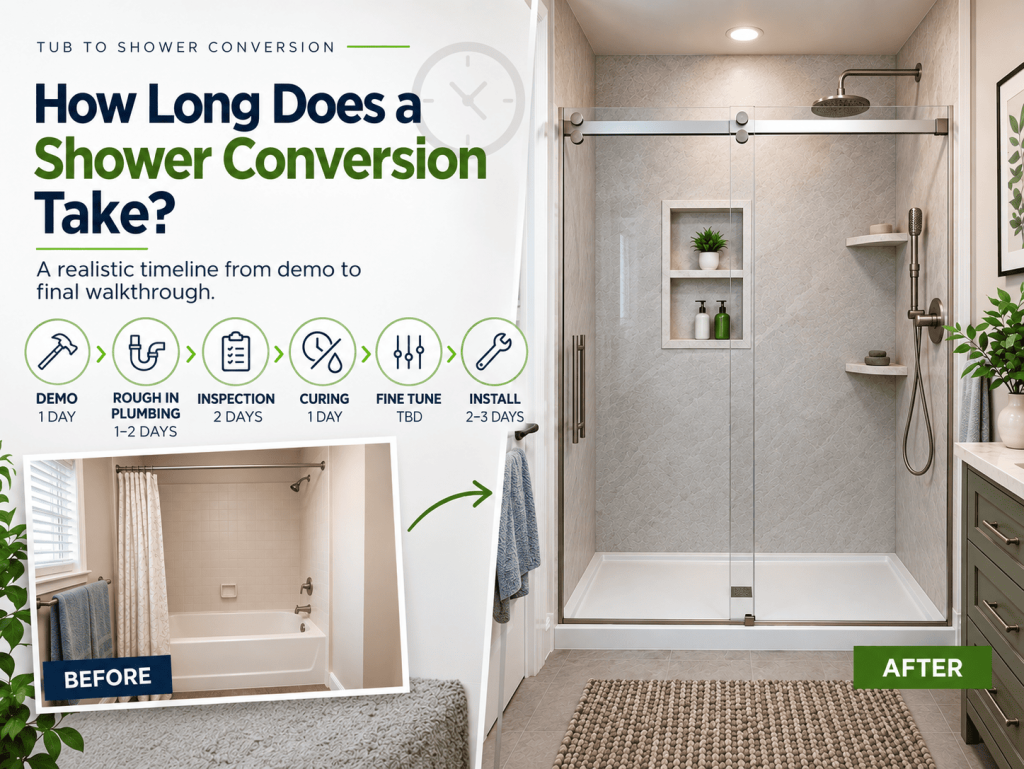
How long does a tub-to-shower conversion take?
At Academy Construction, a standard tub to shower conversion with grout-free materials typically takes 3–5 working days on site, and we give you that schedule before demo starts. We specialize in walk-in shower systems and grout-free options built for Florida’s humid coastal climate. A tile shower can add cure-time waits, because the mortar and membrane layers may need time to cure before tile goes on.
Two distinctions will help you plan. Working days are the days a crew is in your bathroom, while calendar days also include weekends, cure times and waiting for inspections, so the calendar stretch is longer than the working-day count. Install time is also only part of the whole project, because selections, ordering and the permit come before demo, and the glass enclosure and final inspection usually come after the shower is watertight. Ask your contractor whether you can use the shower before the final inspection passes.
Quick Answer: Typical Timelines for a Tub-to-Shower Conversion
What happens before demo day
The first step is to finalize every selection that has to be ordered. That list includes the wall system, the niche and bench, the valve and trim, the showerhead, and whether you want a glass enclosure or a curtain. Changing one of those choices after materials are ordered is one of the easiest ways to push back a start date, so it pays to settle them early.
You should also decide where everyone will bathe while the work is underway. If you have a second bathroom, the conversion is mostly an inconvenience. If this is your only shower, plan for the full calendar stretch rather than just the working days, and keep in mind that adding a new vanity, flooring or a toilet to the same project lengthens the schedule.
Before demo day, Academy gives you a written scope with itemized pricing and a realistic schedule, and we pull the plumbing permit through the right local building department and schedule the required inspections.
Beyond on-site labor, total project windows look like this:
Which permit does a tub-to-shower conversion need?
Florida’s under-$7,500 permit exemption doesn’t cover a tub-to-shower job that involves plumbing, because the exemption does not apply to plumbing work or to work on property in a flood hazard area. The specific permit depends on where you live:
- In unincorporated Escambia County, Building Services lists a Plumbing Fixture Permit for replacing a bathtub with a shower or relocating any fixture.
- In the City of Pensacola, the city requires alteration permits for kitchen and bathroom remodels in which all cabinets and plumbing, gas and/or electrical fixtures are removed or where sheetrock comes off to rough in subtrades.
- In Santa Rosa County, Development Services lists plumbing among its permit types and warns that a permit is usually required for anything beyond minor repairs.
- In Gulf Breeze, the city says that when you build within city limits, you also need a Santa Rosa County building permit, so confirm both the city’s and the county’s requirements before the job is scheduled.
The City of Pensacola adds two timing rules. For improvements over $5,000, the city requires a Notice of Commencement filed with the Clerk of Courts and uploaded to the project, and no inspections can be scheduled before the city receives it. A city permit is also good for 180 days after issuance, and you can request an extension if the work won’t be ready for inspection in that time.
Florida law also sets review deadlines. When the local building department’s own reviewer handles the application, a plumbing permit for an existing single-family home with work under $15,000 must be approved, approved with conditions or denied within 5 business days after a complete and sufficient application. That figure is a legal maximum, not a local average, and the applicant can waive it in writing. It doesn’t mean demo can start within five days, so ask your contractor how long permits are currently taking where you live.
Older homes: lead and asbestos checks before demo
The age of the home can add steps before demo even starts. Under EPA’s RRP rule, anyone paid to disturb painted surfaces in a home built before 1978 must be certified and use lead-safe work practices. Certified renovators can test with EPA-recognized test kits. Florida isn’t on the list of states that run their own program, so EPA administers the rule here.
Asbestos follows a similar logic. EPA says you can’t tell whether a material contains asbestos by looking at it, and it recommends sampling suspect materials such as old floor tile by an accredited inspector before a renovation disturbs them. If testing confirms asbestos in a material the work will disturb, EPA says repair or removal by a trained and accredited asbestos professional is needed. Testing and any abatement come before demo, so schedule them early.

What Affects How Long a Shower Conversion Takes?
No two bathrooms are identical. The timeline for your project depends on the scope of work, the materials you choose, and what’s hiding behind that tub surround. Here are the factors that move the needle:
Day 1: Demolition and what’s behind the tub
Demolition removes the tub and the wall surfaces around it, which exposes the drain, the valve, the framing and the subfloor. Any water damage or rot found at this point has to be repaired before the new shower goes in, so the schedule can change on the first day. How often those problems turn up and how many days they add depends on the house, and nobody can know for certain until the tub is out.
Plumbing, drain and valve changes
After demo, the plumber adjusts the drain and supply lines for the new shower. Before the walls close comes the drain-waste-vent test, which FHBA’s February 2023 course materials place once the rough piping is finished, under the residential plumbing rough-in inspection.
Don’t assume the old tub drain can stay as it is. The drain opening, the drainpipe and the trap are separate questions, and a licensed plumber or your county building department should confirm whether the existing waste line meets code for a shower. Moving the drain or the valve adds work, and on a slab-on-grade house, moving the drain means cutting concrete. How much time that adds depends on the job, so ask for it to be addressed in the written schedule.
The Florida Home Builders Association (FHBA) quotes the Florida Building Code as requiring individual shower and tub/shower combination valves to be pressure-balance, thermostatic-mixing or combination types with a high-limit stop that limits water temperature to not greater than 120° (49°C). Your plumber can confirm the current code wording and help you choose among those types.
Step-by-Step Timeline: From Old Tub to New Shower
How inspections fit into the schedule
Inspections pause the job at set points, which is one reason calendar days run longer than working days. FHBA groups the drain-waste-vent test and the shower liner test under the residential plumbing rough-in inspection.
Local procedures affect how quickly an inspection happens. Santa Rosa County’s plumbing permit application lists a separate shower pan inspection and a final, and it charges additional trip fees when inspections exceed the permit’s standard allowance. In Escambia County, contractors can schedule a same-day inspection online until 6 a.m. or by phone (IVR) by 4:30 a.m. Wait times in the other jurisdictions vary, and the local building department can tell you what to expect.
Shower pan, waterproofing and the flood test
FHBA quotes the Florida Building Code as requiring, where a liner makes the shower floor watertight, the drain to be plugged and the pan filled with potable water at least 2 inches deep at the threshold and held for at least 15 minutes with no leakage.
The waterproofing membrane has to cure before that test, and the product choice and the weather decide whether that takes minutes or a day. LATICRETE’s standard HYDRO BAN typically cures in 2 hours at 70°F or higher and 50% RH, but 24 hours at 50°F–69°F and 70% RH. Custom Building Products says each coat of RedGard typically dries in 1–1.5 hours, but drying can take up to 12 hours in high humidity, which is a real consideration on the Gulf Coast.
A traditional mortar-bed pan and a prefabricated foam pan follow different steps, so ask your contractor which system they use and how its cure times fit the schedule.
Grout-free wall panels or tile
Once demolition and plumbing conditions are known, the wall system you choose is one of the biggest schedule drivers.
Grout-free panel systems skip setting and grouting tile. The panel adhesive and sealant still have cure times, and the panel manufacturer’s instructions govern those. Speed alone doesn’t tell you anything about quality, because a fast job done to the manufacturer’s instructions is better than a slow job that skips them.
Day 2 – Plumbing and structural work: We adjust or replace the drain and supply lines, install the shower valve, and repair any framing issues. If your existing plumbing is in the right spot, this step moves fast.
Last install day: Fixtures, caulk and when you can shower
The trim, the showerhead and the silicone go on last, and the shower is ready for first use once the contractor confirms that every product, including that sealant, has reached its manufacturer’s cure time. Cure times vary by product. GE says its Advanced Silicone 2 can take water in as little as 30 minutes for beads up to 3/16″ at 65°F or above and at least 50% humidity, and otherwise after 8 hours. GE’s Silicone 1 Tub & Tile can take water at 12 hours for beads up to ¼” under similar conditions, and otherwise after 24 hours. For that product, GE says low humidity slows the cure, so Gulf Coast humidity actually helps this step.
A shower you can use is not the same as a finished project, and the next section covers what remains.
After the install: Glass, final inspection and punch list
The project is complete when the glass is installed, the punch list is done and the final inspection has passed. Quoted install days usually don’t include fabricating a custom glass enclosure. Glass lead times vary by fabricator, so ask when the opening will be measured, when the order will be placed and how long fabrication takes. A tension rod and curtain will cover the gap in the meantime. Before you make the final payment, walk the job with your contractor and list anything that still needs attention.
For straightforward grout-free conversions in good-condition bathrooms, these steps compress into 1–3 working days.

Different Project Types and Their Typical Durations
Is a one-day conversion realistic?
A one-day claim depends on what the job includes. A liner or overlay installed over an existing tub is a different job from a tear-out with new waterproofing and drain work, so ask any company offering a one-day install exactly what it removes, what it replaces and whether it pulls a permit.
Project Type | On-Site Work | Total Project Window |
|---|---|---|
Prefab / grout-free swap | 1–3 days | 1–2 weeks |
Mid-range tile shower with factory base | 3–5 days | 2–3 weeks |
Fully custom tile with frameless glass | 5–7 days | 4–5 weeks |
Curbless / barrier-free shower | Add 1–3 days | Varies |
Prefabricated acrylic or fiberglass unit swaps take 1 to 3 days. Custom tile showers require 3 to 5 days for installation. A standard walk-in shower conversion takes 2 to 3 weeks overall, while custom projects can take 4 to 5 weeks to complete. |
Planning a low-threshold or curbless shower
If you’re planning to age in place, decide on grab-bar blocking, a bench and a handheld shower before the walls close. The U.S. Access Board’s ADA guide makes a useful reference point. It permits roll-in shower thresholds up to 1/2″ if properly beveled and floor slopes to the drain of 1:48 maximum, and it notes that flush transitions such as trench drains provide easier access. A curbless entry may require lowering the floor or cutting the slab, which adds time to the schedule.
Frequently asked questions
How much does it cost to turn a tub into a walk-in shower?
The cost depends on the wall system, any drain or valve relocation, damage found at demo, and the glass. Academy gives you a written, itemized quote after seeing your bathroom during a free in-home consultation.
Does Medicare pay for a tub-to-shower conversion?
This article can’t confirm Medicare coverage, so check with Medicare directly. For veterans, the VA’s HISA grant can help pay for medically necessary improvements such as roll-in showers, with a lifetime benefit of $6,800 or $2,000 depending on eligibility. Florida Medicaid’s long-term care home adaptation benefit can include grab bars but not major changes such as plumbing systems.
What happens if the work fails an inspection?
The contractor corrects the problem and the inspection is rescheduled, which adds calendar days.
Local Considerations in the Pensacola Bay Area
Planning your conversion
Once you’ve chosen a wall system, an entry type and a valve, and you know where your household will bathe, ask any contractor you’re considering for a day-by-day schedule that names the inspection points and when the glass will arrive. Academy offers a free in-home consultation to work through those choices. At the end of every job, we walk the finished work with you, take care of punch list items before final payment, and give you written warranty documentation for our labor along with the manufacturer paperwork.
Humidity and hidden moisture. Our coastal climate means mold, rot, and termite damage behind bath walls show up more here than in drier regions. We handle it when we find it, but it’s something to expect as a possibility.
Permits and hurricane season. Permitting turnaround varies by municipality. Storm season (June–November) can also affect material delivery and crew availability. If you’re ready to move forward, planning ahead during off-peak months helps keep things on schedule.
As a local Gulf Breeze contractor, Academy Construction builds these realities into every project timeline. No error in planning, no surprise delays-we know what to look for.