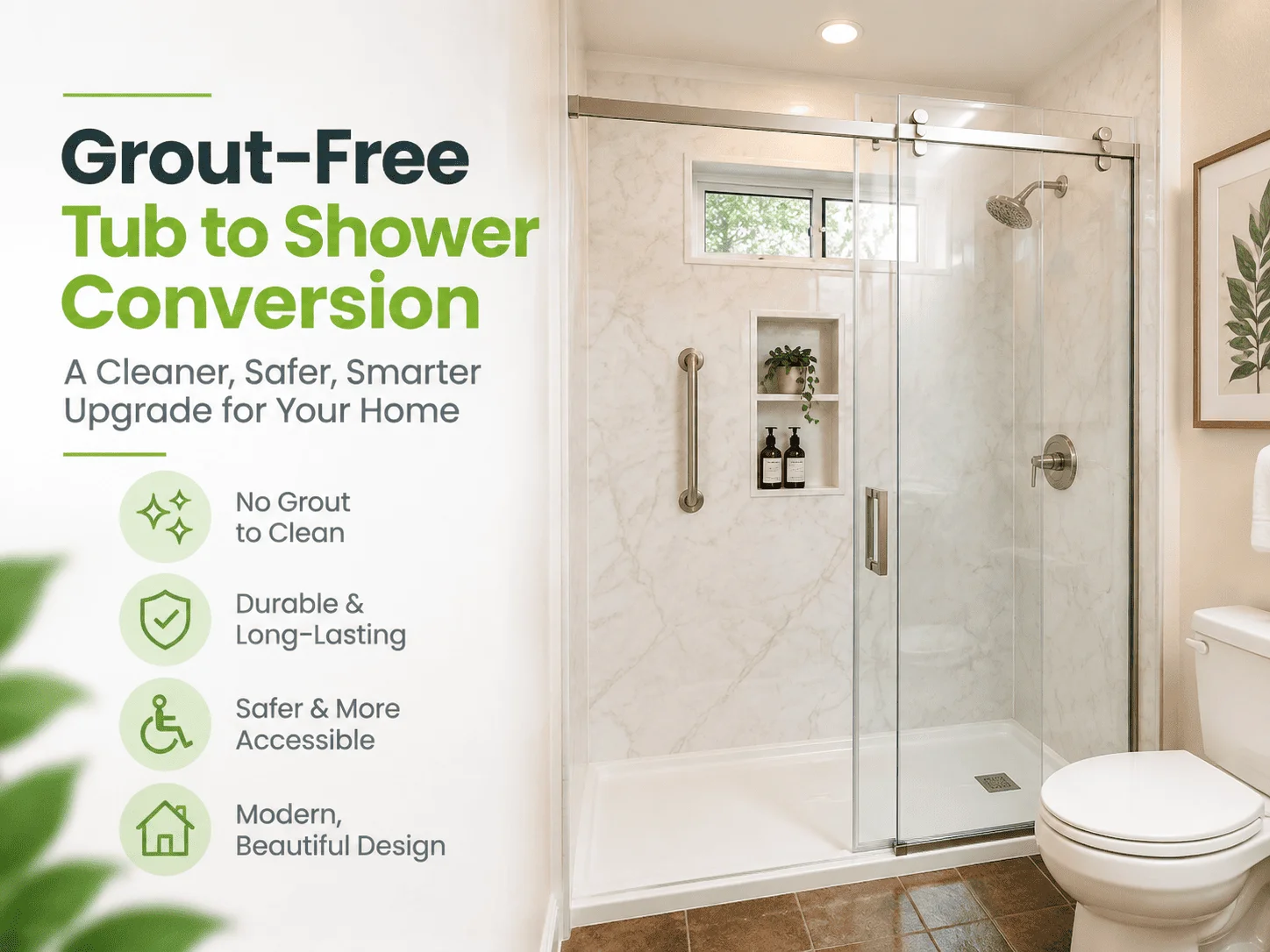
Most of the expensive mistakes fall into four groups: water damage hidden behind the tub, drains and waterproofing built to the wrong standard, safety details such as valve temperature and shower glass, and paperwork gaps such as a skipped permit or an unlicensed plumber. A tub to shower conversion can involve the drain, the valve, the walls and the floor, so it is more than pulling out a tub and dropping in a pan. The ten problems below explain what goes wrong in each case and what to ask or look for before it costs you money.
1. Hidden damage behind or under the tub
Anything behind or under the tub stays out of sight until the tub and wall board come out, so some damage can’t be found or priced before demolition. You can still check for visible warning signs beforehand, such as soft flooring near the tub, loose or cracked tile, stains on a ceiling below and a musty smell that doesn’t clear. Point out anything you find so it goes into the scope of work.
Hidden damage varies too much to price before demolition, because the repair depends on what the crew uncovers. That uncertainty is the reason to ask, before you sign, how hidden damage will be documented with photos, priced in writing and approved by you as a written change order before repair work starts. Set aside a contingency you’re comfortable spending so a surprise doesn’t stall the job.
How We Identified These Critical Problems
These aren’t theoretical. I ranked each problem based on what I’ve seen go wrong on actual conversion projects:
Cost severity – how much it costs when it fails
Safety risk – slip hazards, mold, structural collapse
Project delays – issues that force a complete restart
Florida climate factors – humidity, storms, and termites accelerate decay here faster than almost anywhere else
According to This Old House, roughly 70% of tub-to-shower conversions involve at least one hidden cost-structural repair, water damage, or plumbing upgrades. That stat matches what I see in the field.
10 Critical Problems That Can Derail Your Shower Conversion
2. Assuming the old tub drain will work for a shower
An old tub drain isn’t automatically right for a shower. The drain opening you see, the trap under the floor and the pipe that carries water away are separate parts, and each one has to suit the new fixture. Have a licensed plumbing contractor confirm in writing whether the existing drain pipe size meets code for the shower you’ve chosen, whether the trap has to move, whether the venting still meets code, and whether any slab cutting or ceiling access below is in the scope, before the base is ordered or the floor is opened. Under Florida law, a plumbing contractor’s work includes sanitary drainage.
The entry style affects the drain as well, because a curb, a low threshold and a curbless entry each ask different things of the floor around it. If your house sits on a concrete slab, ask the plumber how the drain would be reached and what that work adds before you settle on an entry.

1. Inadequate Waterproofing Behind Walls
This is the single most expensive mistake I see homeowners make. Inadequate waterproofing can cause significant water damage that stays hidden for months or years. Waterproofing failures can compromise the entire house structure-not just the bathroom.
3. The wrong board behind the shower walls
Paper-faced drywall and greenboard are poor choices behind a shower. Federal DOE guidance from the Building America Solution Center says paper-faced gypsum board should not be used in wet areas and that moisture-resistant gypsum and greenboard are not recommended behind tub surrounds. The guide recommends cement board or an equivalent moisture-resistant backer board behind tiled or paneled tub and shower walls. Its list of alternatives includes fiber-cement, glass mat gypsum and fiber mat-reinforced cementitious backer panels. This is a federal recommendation rather than Florida code text, but it gives you a clear question for every bidder: if the shower is tiled, which backer board will go on the walls, and if it’s a panel or surround system, what substrate or framing does the manufacturer require?
Who’s at risk: DIY installs, bargain contractors who treat waterproofing materials as optional, and rushed projects where cure times get skipped.
Warning signs: Contractor can’t name the membrane product they’re using. No visible lapping at seams. Gaps at penetrations like niches or plumbing fixtures. Standard drywall behind tile instead of cement board.
4. Treating tile, grout or cement board as waterproof
Cement board solves the drywall problem but not the waterproofing problem. The same DOE guide explains that cement board is water resistant but not waterproof unless it’s specifically made as a waterproof product. The guide calls for a fluid-applied waterproofing coat on its surface or a draining water-resistant barrier behind it. Tile and grout are the finished surface you see, so ask which waterproofing system stops the water (a liquid-applied coat, a sheet membrane, a waterproof board or panel, or a barrier behind the board) and where it sits. The Ceramic Tile Foundation, an industry group, says tile itself is not a waterproof barrier, which is why tiled showers depend on a separate water barrier behind the tile. Ask the contractor which build you’re paying for and how its seams, corners, niches and penetrations will be sealed.
2. Improper Shower Pan Slope and Drainage
5. A shower base that isn’t built to the plumbing code
For prefabricated units, the Florida Building Commission’s summary of changes to the 2023 Florida Building Code, Plumbing notes that Section 421.1 now permits prefabricated showers and shower compartments complying with ASME A112.19.2/CSA B45.2 and ASME A112.19.3/CSA B45.4. If you choose a prefabricated shower or shower compartment, ask for documentation that the product complies with those standards, as applicable.
For a site-built pan, ask who checks the slope to the drain, how the seams, corners and curb are detailed under the manufacturer’s instructions, and whether a flood test is done. Ask the contractor to name the pan method in the written scope and explain how the slope, liner or membrane, curb and drain connection will be handled, then check with your local building department what the permit inspection covers. For any floor surface, ask the manufacturer whether it is rated for slip resistance in wet areas.
6. A shower valve that can scald
The valve controls how hot the water can get, so ask about it directly. According to the Florida Building Commission’s analysis, Section 412.3 of the 2023 plumbing code adds language requiring shower control valves to be rated for the flow rate of the installed showerhead. It also requires their temperature-limiting devices to be field-adjusted to no more than 120°F. Ask the contractor to confirm the valve is rated for your showerhead before the walls are closed, then have the plumber test and set the maximum hot-water temperature once the valve is trimmed out.
The summary doesn’t name a valve type, so a licensed plumber should tell you whether a pressure-balancing or thermostatic valve fits your plan. While the plumbing is open, you can also decide whether to keep the valve where it is, add a handheld shower or replace a tub/shower valve and diverter with a shower-only valve.
Most common in: Budget installations and DIY projects where the mortar bed is poured too flat or a prefab pan doesn’t quite fit the space.
Warning signs: Standing water after use, slow drain, faint water stains at the base of walls, musty smell from the ceiling below.
Consequences: Water seeps under tile, adhesive fails, grout washes out, and the subfloor rots. Full shower pan replacement runs $900–$2,300 or more.
3. Skipping Proper Plumbing Rough-In Changes
7. A bathroom fan that can’t keep up with the humidity
A new shower adds steam to a house that already deals with Gulf Coast humidity. EPA says the way to control indoor mold growth is to control moisture, and it recommends keeping indoor humidity at 30–60%, partly by venting bathrooms to the outside.
DOE’s Building America guidance recommends leaving the fan running for one hour after a shower, ideally on a timer switch that turns it off automatically. While the bathroom is torn up, ask where the existing fan actually exhausts and whether it’s worth upgrading.
8. Shower glass that isn’t safety glazing
The Consumer Product Safety Commission’s federal standard, 16 CFR Part 1201, covers glazing in shower doors and enclosures as well as bathtub doors and enclosures, and it requires those products to be built with glazing that meets the standard. Ask the contractor or glass supplier to confirm in writing that your door and any fixed panel meet Part 1201. If glass doesn’t suit your budget or layout, a curtain is a reasonable alternative.
Risk is highest when you use a handyman instead of a licensed plumber. I’ve seen old galvanized supply pipes crumble the moment someone tries to work on them.
Signs of trouble: Low water pressure, temperature swings mid-shower, gurgling drains (improper venting), or sewer gas smell.
4. Using Materials Not Rated for Wet Environments
9. Lead paint, asbestos and dust in older homes
If your house was built before 1978, EPA’s Renovation, Repair and Painting Rule generally requires paid work that disturbs paint to be done by an EPA-certified renovation firm, including sole proprietors, following the rule’s training, education and work-practice requirements. Demolition isn’t treated as minor repair work: EPA considers demolition to be removing or disrupting a painted component in a way that destroys or ruins it. For these projects, EPA recommends hiring a lead-safe certified contractor.
In an older home, ask how suspect materials will be checked before they’re disturbed, who orders any test and what happens if asbestos is found.
Whatever the house’s age, ask how the crew will protect your floors, which rooms or doorways will be sealed off with plastic, how dust will be collected and how often the work area will be cleaned.
I’ve walked into homes where a previous contractor left thinset tracked through the hallway and dust coating every surface in the master bedroom.10. Skipping the permit and inspection
Escambia County requires a Plumbing Fixture Permit to replace a bathtub with a shower or shower pan or to relocate any fixture, while strictly cosmetic work such as painting generally doesn’t need a building permit. The City of Pensacola requires an alteration permit for bathroom remodels in which all cabinets and plumbing, gas and/or electrical fixtures are removed, or when sheetrock comes off to rough in subtrades.
Starting July 1, 2026, the city exempts non-structural work on a single-family home valued under $7,500. The exemption isn’t automatic; owners have to apply for it. The city’s exemption application asks you to certify that the job isn’t electrical, mechanical, plumbing or gas work, so a conversion that involves plumbing wouldn’t qualify; ask Building Inspections if you’re unsure.
Santa Rosa County’s general guidance doesn’t mention conversions, but it lists plumbing as a permit type and says a permit is most often required except for minor repairs. In Gulf Breeze or Milton, call your city’s building department. On Academy projects, the required plumbing permit is pulled with the local building department and the work goes through inspection, which gives you an independent check on what goes behind the walls.
Will Medicare or another program help pay for the conversion?
Medicare is unlikely to pay for this project. Part B covers medically necessary durable medical equipment used in the home, and its list of covered items, from canes and commode chairs to walkers and hospital beds, includes no bathroom remodeling. Florida Medicaid’s long-term care Home Accessibility Adaptation service can include grab bars, but it excludes major changes such as plumbing systems.
Other programs may help if you qualify. The VA’s HISA program can help eligible veterans with access to essential bathroom facilities. It pays a lifetime benefit of up to $6,800 to address a service-connected disability, or a non-service-connected disability when the veteran has a service-connected disability rated at least 50 percent, and up to $2,000 for a disability not covered by those categories. The amounts are subject to change, and the program requires a prescription from a VA or fee-basis physician. The Escambia County and Pensacola SHIP plan covered fiscal years 2022–23 through 2024–25 and limited accessibility help for very-low- and low-income owners to a grant of $10,000 or less. The plan itself doesn’t confirm funding after 2024–25, so check with the county before counting on it.
The ADA doesn’t cover strictly residential private homes, so accessibility features in your house are your choice. Before the walls close, decide whether to add blocking for future grab bars and a bench or seat.
Warning signs: Within months, grout darkens unevenly, tiles sound hollow when tapped, fasteners show rust stains, or new drywall swells behind the shower system.
5. Inadequate Ventilation Planning
What drives the cost and how long a conversion takes
Conversion prices vary because the number depends on the choices covered above, including the base and wall system, whether the drain or valve moves, glass or a curtain, a fan upgrade and any damage found during demolition. Because those choices vary, a lower quote may not cover the same work as a higher one, and the fair way to compare is line by line. Academy provides a written scope with itemized pricing and a realistic schedule before demo day. For a standard conversion with grout-free materials, we typically schedule 3–5 working days and share that schedule before demo starts.
How to check the contractor before you sign
Santa Rosa County says Florida requires contractors to hold a state certification, state registration or specialty trade license in the field, and Santa Rosa County warns that a Business Tax Receipt alone isn’t proof of a license. The county sends homeowners to the Florida Department of Business and Professional Regulation website to check. State law also requires a contractor to subcontract plumbing work unless it holds a plumbing certificate or registration, and the same chapter’s $2,500 minor-work exemption in Section 489.103 doesn’t cover a piece of a larger job, a job split up to avoid licensing, or a person who advertises as a contractor. Before you sign, work through this checklist:
- Ask for the contractor’s state license and check it on the DBPR website.
- Ask for proof of insurance.
- Ask who will pull the permit and who will do the plumbing.
- Ask for the firm’s EPA lead-safe certification if the house was built before 1978.
- Ask for a written, itemized scope that names the base, wall system, backer board, waterproofing, valve, glass and fan.
- Ask for the labor warranty in writing, along with the manufacturer paperwork.
Academy is licensed and insured. At the end of every job, we walk the finished bathroom with the homeowner, take care of punch list items before final payment, and hand over written warranty documentation for our labor alongside the manufacturer paperwork.
Before you call for quotes, make the choices that shape the price: the entry style, the base and wall system, glass or a curtain, the valve, grab-bar blocking and the fan. Ask every contractor the same questions about drain size, backer board, waterproofing, valve temperature, glass and permits, and compare their written answers side by side, because the bid that answers each one clearly is the one you can hold the contractor to.
Biggest risk: Older homes where the fan vents into the attic instead of outside, or where there’s no fan at all. Proper ventilation isn’t a nice-to-have. It protects every other investment you’ve made in that bathroom.
Warning signs: Condensation lingering long after a shower, foggy mirrors that won’t clear, peeling paint, warping door frames, musty odors.

6. Ignoring Future Accessibility Needs
I always recommend homeowners think about future accessibility, even if they don’t need it today. Retrofitting grab bars or a low-curb shower after tile installation means opening up walls again.
One more thing: maintaining at least one bathtub in a family home can be important for resale value. If your house has only one tub, think carefully before removing it.
7. Incorrect Measurements and Space Planning
Consequences: Returned components, delays, extra cutting, compromised waterproofing to force a fit, and wasted budget.
8. Poor Tile Work and Grout Installation
Tile installation in a shower is unforgiving. Unlike a kitchen backsplash, your tile shower takes direct water contact daily. Substrate flatness, mortar coverage, grout type, and sealing all matter.
Risk is highest with low-bid contractors or DIY tile work where corners get cut on mortar coverage or grout sealing. In Florida’s humidity, unsealed grout grows mildew within weeks.
Warning signs after install: Grout cracking, tiles that sound hollow when tapped, uneven spacing, discoloration, water bleeding through joints.
Consequences: Tile failure, water penetrating the substrate, moisture damage to framing below, and eventually a full tear-out. Many of these issues are covered in depth in our bathroom remodeling FAQs on shower systems.
9. Rushing the Project Timeline
Removing a bathtub can unearth hidden water damage and rot. Removing a heavy tub can reveal uneven or damaged subflooring. These aren’t problems you can rush through-they need proper assessment and repair before the install continues.
Warning signs: A contractor promises a complex job in two days. Pressure to accept work before inspections. Components missing during the process.
Consequences: Latent failures, leaks that appear weeks after the job is “done,” voided manufacturer warranties.
10. Choosing Contractors Based Only on Price
This is the root cause behind most of the other nine problems. When a bid seems too low, somebody is planning to skip something-waterproofing, proper materials, permits, or quality labor.
Red flags: No licensing or insurance. No written contract. Vague descriptions of waterproofing. No local references. Unwillingness to pull permits.
Consequences: No warranty protection, difficulty getting redress, poor work that becomes expensive professional installation work later, and insurance claims denied if code violations surface.
Quick Reference: Most Critical Problems by Risk Level
Risk Category | Problems |
|---|---|
Immediate safety | Improper drainage (#2), accessibility gaps (#6) |
Highest cost | Waterproofing failure (#1), wrong materials (#4) |
Long-term damage | Inadequate ventilation (#5), rushed timeline (#9) |
Project-ending | Measurement errors (#7), unqualified contractor (#10) |
How to Protect Yourself From These Problems
During Planning Phase
During Installation
Before Final Payment
Which Problems Should Worry You Most?